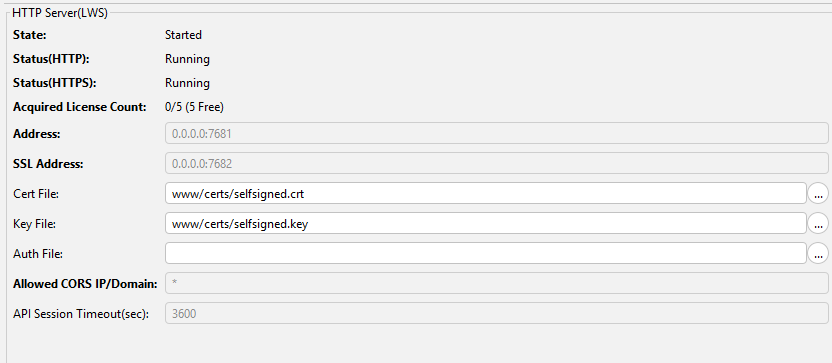
The HTTP Server (LWS) tab is used to configure and manage the Lightweight HTTP/HTTPS Server running on a deviceWISE node. This server provides HTTP and HTTPS endpoints for inbound communication and is designed to offer a more flexible, file-based security and TLS configuration model than legacy HTTP server.
The HTTP Server (LWS) supports modern TLS configurations, externalized authentication and independent HTTP and HTTPS listeners.
Supported Use Cases
The HTTP Server (LWS) is used to:
-
Support the HTTP Page Listener trigger event type.
-
On Asset Gateways, the HTTP Server is used to support the Asset Gateway: Web Interface.
-
Enable externally managed authentication mechanisms.
-
Support inbound HTTP-based integrations.
-
Provide secure HTTPS access using custom certificates and keys.
The HTTP Server (LWS) is a distinct implementation from legacy HTTP Server and uses a different configuration, security and licensing model.
The HTTP Server is not supported on the following product:
- Mitsubishi MESInterface IT
Configuring the HTTP server (LWS)
All configuration parameters for the Lightweight HTTP Server are available under Administration > HTTP Server (LWS)
Server State and Status
| Parameter | Description |
|---|---|
| State | Indicates the overall server state. Possible values areSTARTED or STOPPED. |
| Status (HTTP) | Displays the runtime status of the HTTP listener. |
| Status (HTTPS) | Displays the runtime status of the HTTPS listener. |
HTTP and HTTPS Listeners are managed independently and may be enabled or disabled separately depending on the configuration.
Licensing
| Parameter | Description |
|---|---|
| Acquired License Count | Displays the number of HTTP Server (LWS) licenses currently in use and the total number available. A limited number of free licenses may be included with the base runtime. |
Each active client session that connects to the HTTP Server (LWS) consumes a license while the session remains active. Once the session ends the license is released and becomes available for reuse.
Network Configuration
| Parameter | Description |
|---|---|
| Address | The IP Address and port used for HTTP access. The default value is 0.0.0.0:7681. Using 0.0.0.0 causes the server to listen on all enabled network interfaces. |
| SSL Address | The IP Address and port used for HTTP access. The default value is 0.0.0.0:7682. Using 0.0.0.0 causes the server to listen on all enabled network interfaces. |
If a specific IP address is provided instead of 0.0.0.0, the server will only listen on that interface.
TLS Configuration
HTTPS support in the HTTP Server (LWS) is configured using explicit certificate and key files.
| Parameter | Description |
|---|---|
| Cert File | Path to the TLS certificate file used by the HTTPS listener. |
| Key File | Path to the private key associated with the TLS certificate. |
The certificate and key files must be accessible to the deviceWISE runtime and provided in a supported format.
Authentication Configuration
| Parameter | Description |
|---|---|
| Auth File | Path to an authentication configuration file used by HTTP Server (LWS) |
The authentication file allows authentication behavior to be defined externally to the Workbench user model. This enables integration with file-based authentication, token based authentication and other externally managed mechanisms.
Unlike the legacy HTTP Server, the HTTP Server (LWS) does not use deviceWISE users or passwords defined in Administration > Security.
Cross-Origin Resource Sharing (CORS)
| Parameter | Description |
|---|---|
| Allowed CORS IP/Domain | Specifies which client IP addresses or domains are allowed to access the HTTP Server (LWS) using cross-origin requests. A value of * allows requests from any origin. |
This setting is required when the HTTP Server (LWS) is accessed by browser-based clients or web applications hosted on a different origin.
Session Management
| Parameter | Description |
|---|---|
| API Session Timeout (sec) | Specifies the session timeout, in seconds, for API sessions. The default value is 3600 seconds. |
If a session remains inactive beyond the configured timeout, it is automatically terminated and the associated license is released.
The Save button is used to save any change to the parameters. Configuration changes must be saved before starting or restarting the server for the changes to take effect.
The Start Server and Stop Server buttons control the HTTP Server's status.
The Refresh button refreshes the displayed status and runtime information.
 Related Topics